Cut Marketing Optimization Costs by 99%: AI Customer Agents That Simulate Real Buyers in Minutes
For most websites, the cost of marketing optimization has never been higher.
This is due to three major forces:
- Soaring advertising costs: Over the last decade, Facebook's cost per 1,000 impressions has skyrocketed from single digits to double digits, representing a more than 10-fold increase.
- Stricter regulations: Privacy policies (cookies, Apple restrictions, GDPR) make it harder to target homogeneous audience segments.
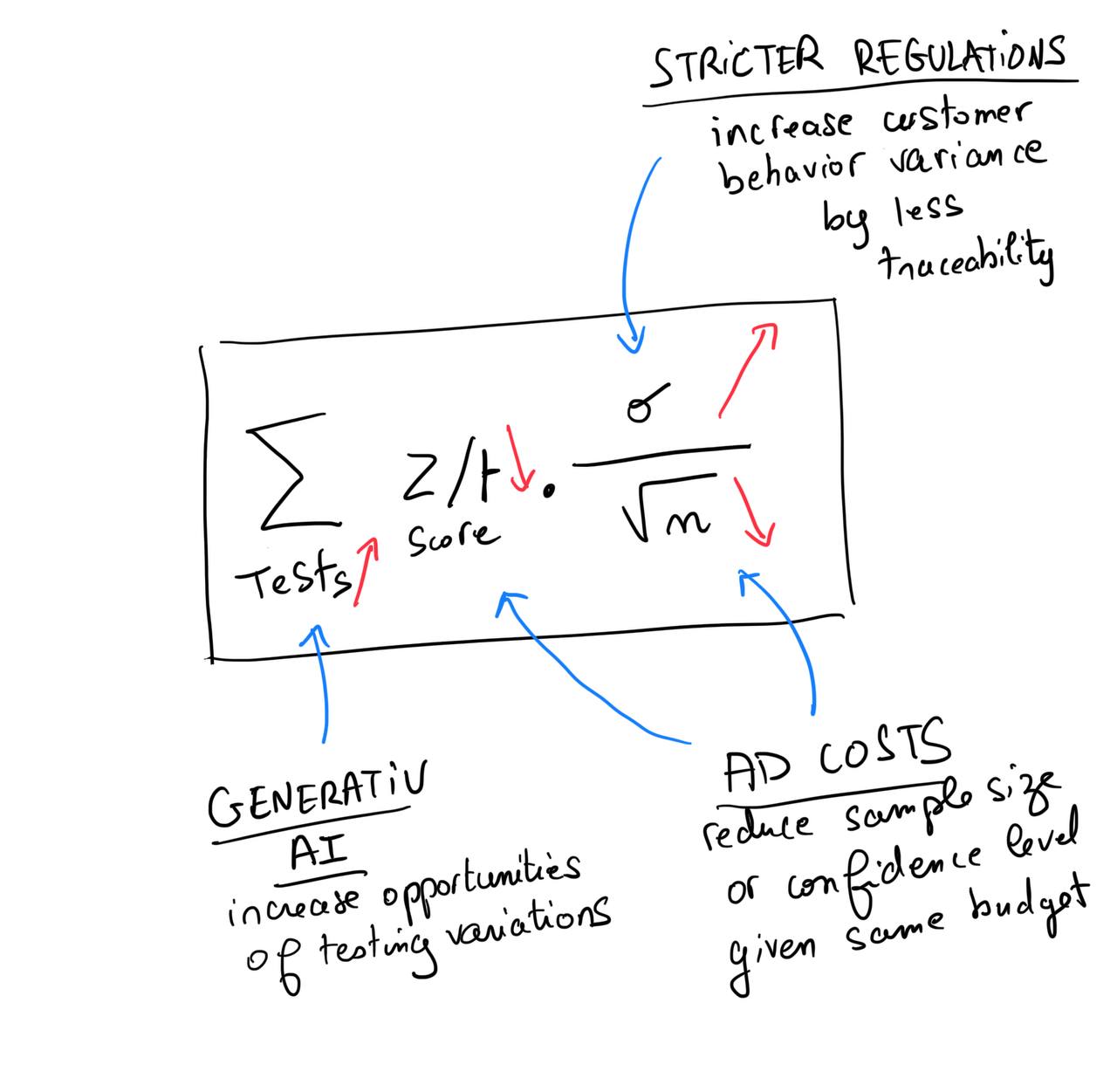
- The explosion of generative AI: While AI unlocks endless testing possibilities, achieving statistical significance now requires more traffic, so larger budgets.
The cost of marketing experimentation
Think of it like this:
- In one part of the equation, customer segments are becoming less consistent, so behavorial customer variance is increasing. Cohorts are less homogeneous, regulations restrict tracking, and user behavior is harder to predict.
- On another part of the equation, the cost to gather statistically significant data is rising because of ad costs, with the confidence level requirement remaining unchanged. It costs more today to test a small variation than 10 years ago.
- Multiply this by theoretically unlimited tests that generative AI makes possible, and the cost of optimization spirals out of control.
- Worse, 8 on 10 of A/B tests fail, meaning you often don’t even improve your control version.
Your current options? Not great.
To outcompete in marketing, you seem to have two choices:
- Hire the top 0.1% of copywriters: Make big bets on messaging to minimize required sample sizes and failure rates.
- Burn cash on ad platforms: Either increase customer lifetime value (LTV) to fund ongoing testing or raise VC money to keep feeding the ad machine, which wins whether you do or not.
For 90% of businesses, these aren’t real options.
Most SMBs are left guessing, using generative AI to create endless variations but still paying the attention tax to ad platforms. Many copy competitors, hoping they know better, only to mimic the same uncertainty.
But it doesn’t have to be this way.
For decades, marketing was about creativity and market studies. Hiring experts (think Don Draper) to understand customers.
Then came data-driven validation. Make surveys or launch a landing page to see if it converts.
We think there is a third way, having the advantage of qualitative insights (like user interviews) and the scaling power of quantitative validation (A/B testing).
Learning quantitatively.
What if every company could validate every variation almost instantly, discovering what outperforms their control version at just 1/100 of their current ad spend?
What if AI-powered synthetic customers behaved like real buyers, shaped by millions of years of genetic selection, current mimetic desires, and offer fatigue?
Introducing AI customer agents
These AI-generated consumers simulate real customer behaviors.
They accelerate learning and improve consistency.
The truth: Most conversion success comes from deep customer research. AI can now accelerate and refine this process, continuously updating insights with ever-evolving mimetic desires and promise fatigue. It transforms qualitative data into thousands of AI-driven simulations, unlocking precision at scale.
Now, instead of spending months running expensive tests, you can optimize quantitatively. Without the waiting, uncertainty, or wasted ad spend.
How it works
- Define your target with the same criteria of your ad platform. Generate 1,000 synthetic “luxury skincare moms” or “thrifty SaaS founders.”
- Load-test your campaigns. Let reinforcement learning or any optimization method pit 100 variations against these AI buyers, testing headlines, pricing, and layouts in HOURS. Not MONTHS. You can even give your customer AI agents to your other marketing and sales AI agents. They will iterate together until getting a strong conversion threshold.
- Launch what wins. Deploy web pages or any marketing material proven to convert on a specific customer segment before spending thousands in real ad spend.
Our AI customer agents will be trained on:
- Demographics & psychographics: Millions of years of evolution have shaped the way our brains process decisions.
- Real-time mimetic desires and offer fatigue: Live social signals tracking the desires, and the offer fatigue influencing customer decisions.
- Specific behavioral data: Insights into customer purchase hesitation, impulse triggers, and abandonment patterns.
They click, hesitate, drop off, and convert. Just like real buyers.
But before you ever spend a dollar on ads.
No more guessing. No more wasted budget.
Test in a lab, launch with precision, and win.
The first AI agents that may actually buy from you.
A note on the competitive landscape
Traditional players in marketing optimization typically focus on providing tools for companies to gain qualitative insights from their customers or on validating (or betting against) variations in the ad industry.
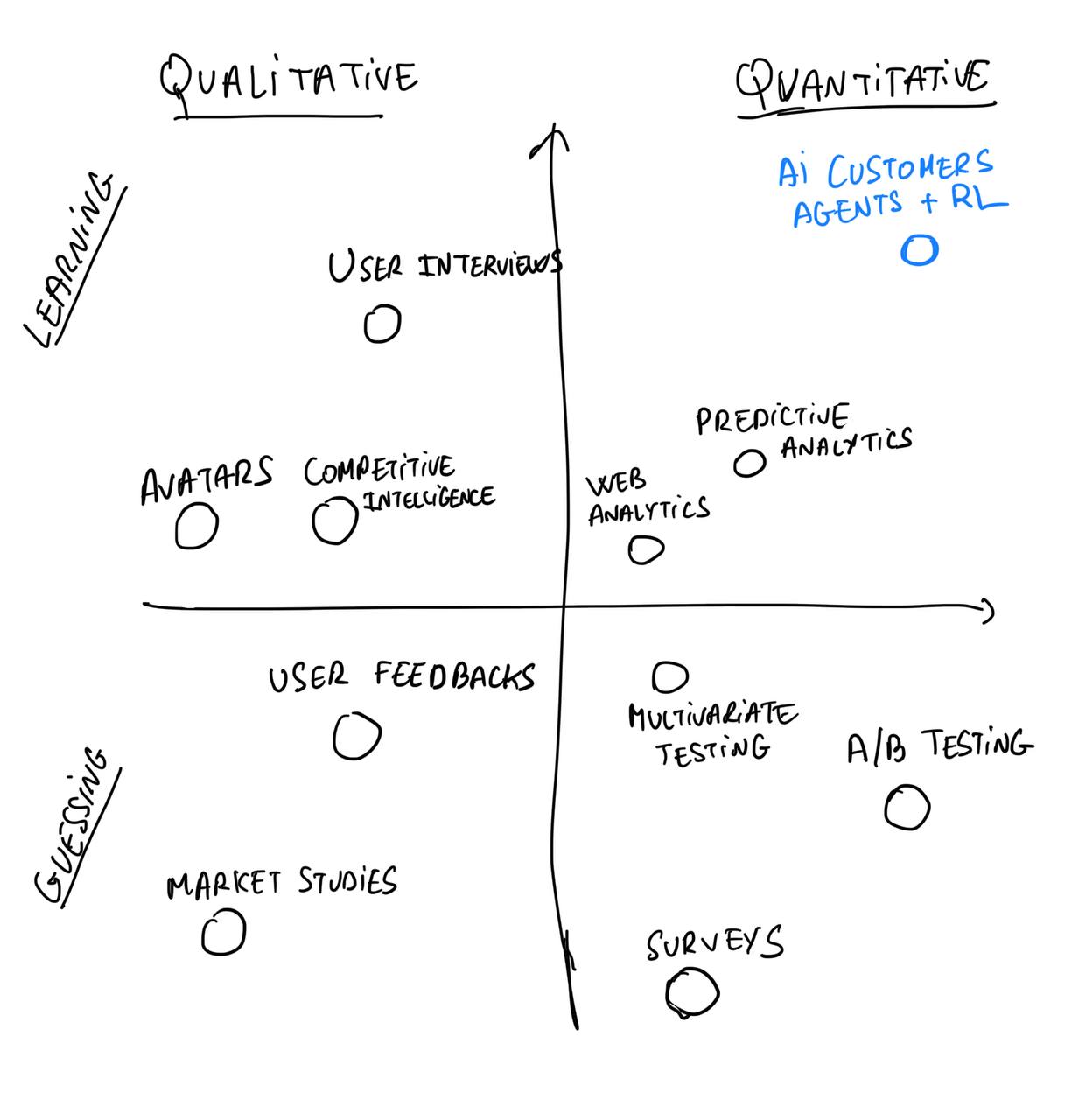
This leaves a gap in the market for the most advanced form of marketing optimization: quantitative learning.
It creates an opportunity for large companies to run continuous experiments in a controlled sandbox environment and enables smaller companies to validate their marketing strategies before spending a cent on ads.
As for more innovative players, most AI agent initiatives focus on the supply side. Generating content, automating sales, and handling customer support. Their implicit goal is often to replace employees with AI agents.
However, few tackle the demand side: simulating real customers to refine how businesses sell.
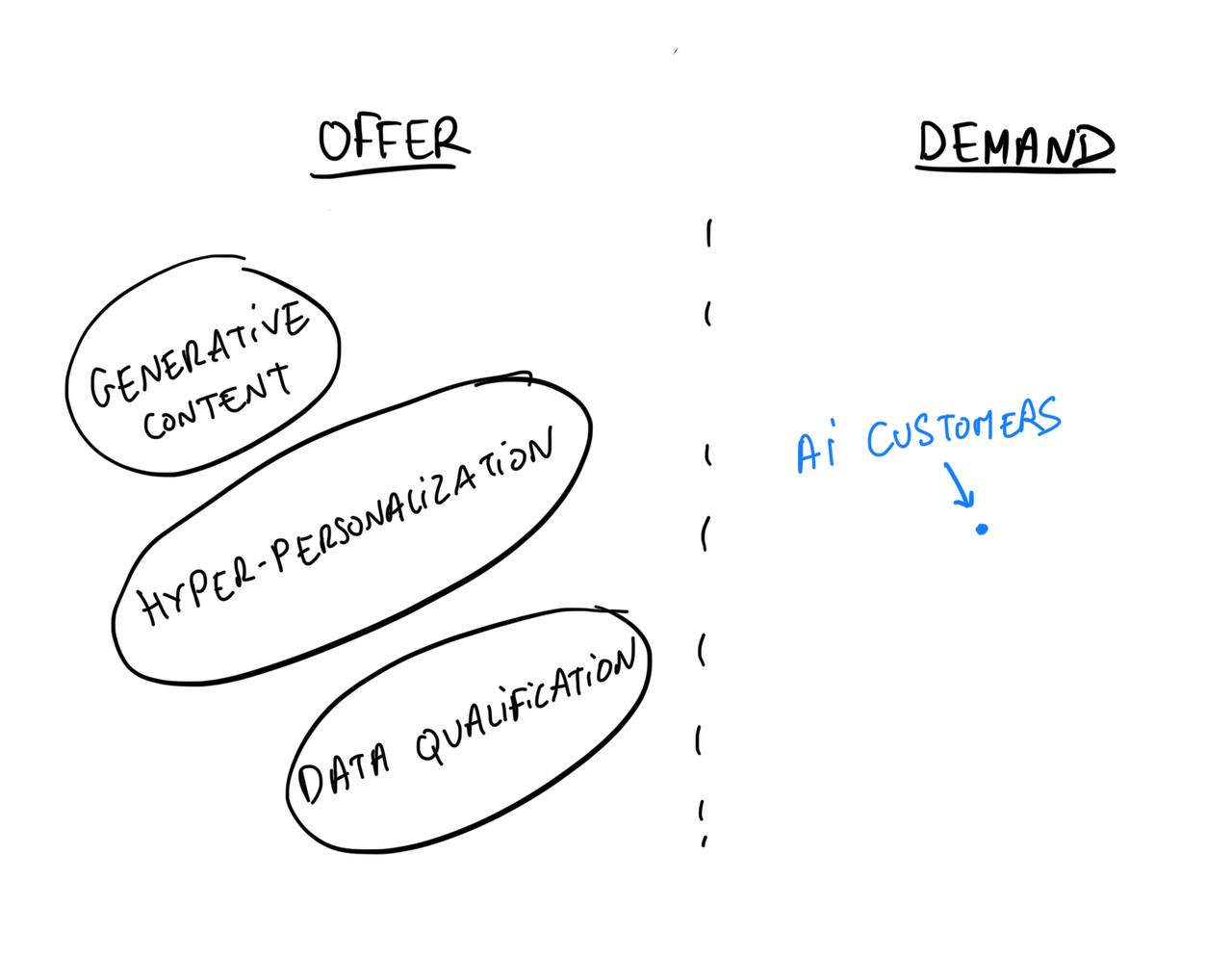
Without an accurate feedback loop, AI-driven sales operate blindly, relying on trial and error instead of customer intelligence.
And this accurate feedback loop doesn’t need to be expensive, even supervised, to be relevant.
A last note about the market opportunity
As seen previously, slashing the cost of learning by two orders of magnitude opens the market for marketing optimization to 90% of other companies, mostly SMBs, that lack a large volume of traffic or customers to generate statistically significant insights at scale.
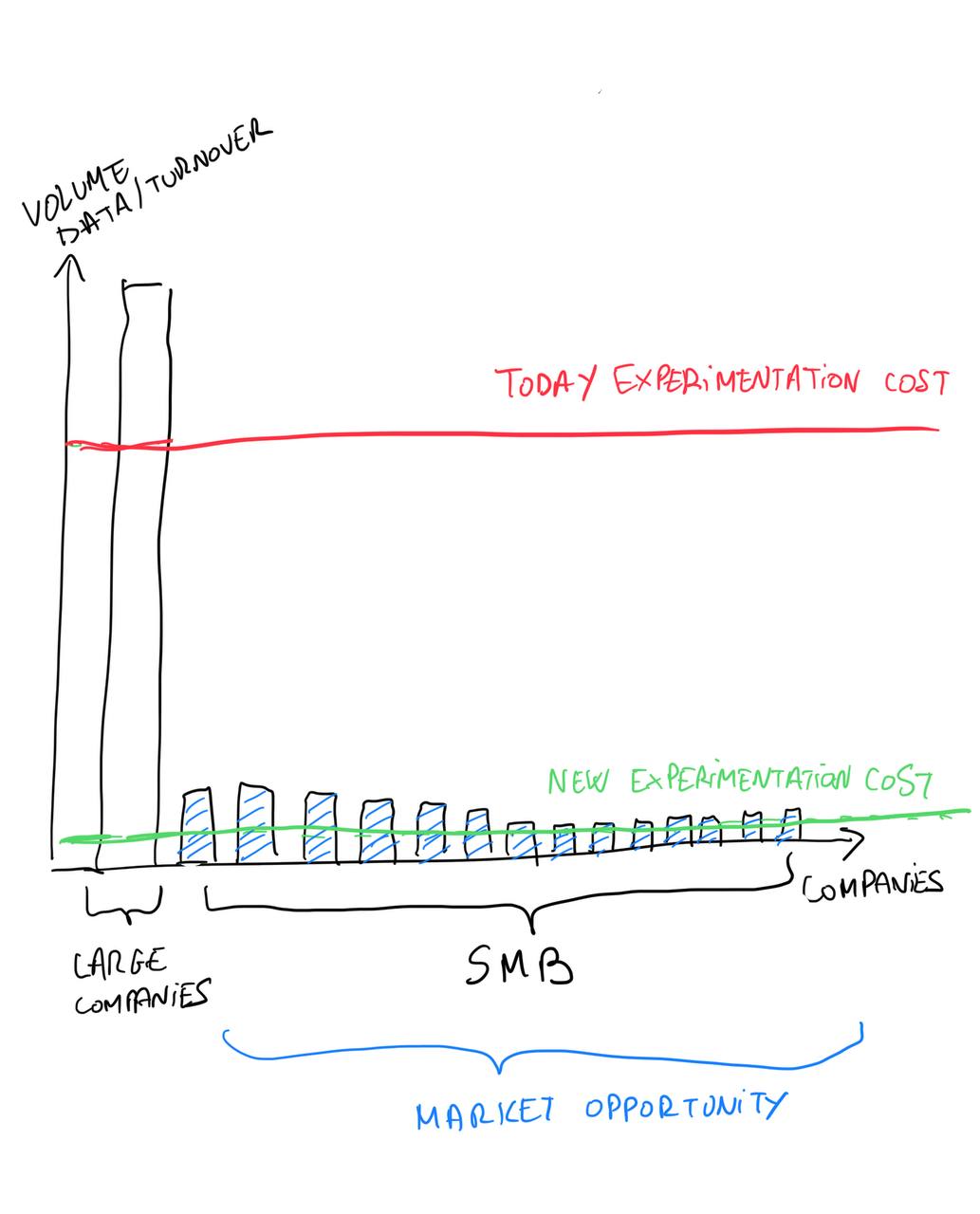
These companies are currently underserved by the market. So its where we will narrow our focus until we develop a customer AI agent in a specific segment that is efficient enough to deliver results.
We are 2 cofounders, a freelance developer and a marketing infopreneur, online-street-smart enough to survive, with several years of experience in selling online in french B2B and B2C markets. So we will train a customer AI agent on our current data, incorporating real-time insights from current mimetic desires and specific offer fatigue sentiments.
Our focus will be on 1 single use case at first : making landing pages win for entrepreneurs in education or e-commerce (where we currently operate).